Saturday, November 28, 2009

The 2009 edition of Midwest Haunted Rails

One of the last props to be completed for the Midwest Haunted Rails was the animated alligator (commonly referred to as Alligator Version 1.0).

The incredibly lifelike foam beast sits on top of its shipping crate awaiting the handiwork of Jesse V and Dustin B.


The bottom side of the beast shows some of the metal framework. The framework supports the various pneumatic cylinders and hinges necessary for the movement of the mouth, legs, and tail.


After the initial fitting into the body, several additional brackets needed attaching.


Dustin B. makes some cuts in the beast's mouth so it will accept the lifting mechanism. It does look like the beast is trying to eat Dustin.


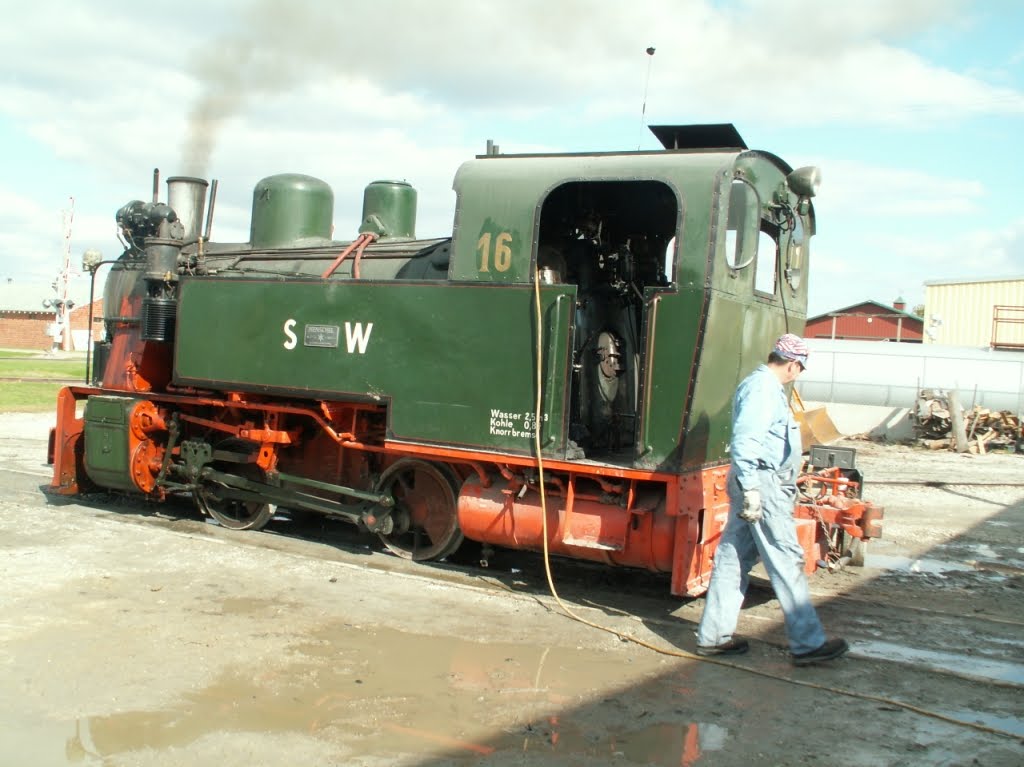
On the first operating day of the Haunted Rails, the 16's fireman, Kim W. backs his pickup truck to the cab to transfer wood. The 16 starts on wood and is switched to coal once the steam pressure starts building.


Until steam pressure is available, the steam locomotives require air pressure to operate the atomizer (9) and the blower (9 and 16). As can be expected, something is bound to go wrong with the hardware at the MCRR. This time, it was the gasoline rotary screw air compressor that didn't want to work.

Roger R. examines the carburetor for problems. The compressor would fire but not idle or sustain steady high rpm operation.




Fireman Brian B. detaching the airhose from the 9's feed point.


Coiling the hose after use.


Jennifer B. holds the CPVC frame for one of the props at the"CarnEvil" exhibit at the south station's east end.


Nathan V. keeping the 9's boiler at pressure before handing it over to the designated fireman for Ghost Train.


Hey! Who was using my camera?


John G. must have lost some tools and decided they were on top of the 16.


After checking on the source of a seemingly large water leak, the author tightens the nuts holding the smokebox door shut. Brian B's decoration is shown in position over the 9's number plate.


The next few pictures are of the props in the "spook house" also known as the South Station.

Dear to many MCRR volunteers is the 6, the 2-6-0 Baldwin Locomotive. Down for boiler repairs, Griffin W. made this incredible grave marker in its honor.

We are still raising funds for the restoration of the 6. Check the 6's webpages for details.


This is Jennifer B's "CarnEvil" exhibit. The CPVC frame she was holding in the earlier picture was dressed and appears as one of the figurines in the next two pictures.


The author, an honorary (perhaps "ranking member") of the "Henschel Wrecking Crew" is contemplating his next move in firing the 16.


"Gee...the reception isn't too good on this old TV screen."


Fooling with the train brake actuator.


Longtime MCRR member Jim B. sits in the driver's seat of the 9.


Griffin W. drains the water from the tender's oil tank before firing the boiler while Brian B., Dustin and Braden B. supervise.


-steam.airman

October 2009 Work Weekend (2009-12-24 Update)

With the following week being the first Ghost Train (actually called "The Midwest Haunted Rails Featuring the Ghost Train of No Return and the Ghostly Trolley") it was thought a few repairs to the rolling stock was in order.

During the Old Threshers' Reunion, the grease monkey noticed the Quinn Coach had some bearing issues that warranted attention. The thrust surfaces on all four axles were quite warn allowing far more side to side travel than ideal. Fixing the problem required pouring new bearings on all 8 journals (4 axles times two bearing surfaces per axle).

One of the many challenges of pouring bearings is a proper mold to form the molten metal prior to machining. In the past, we have removed the axle from the truck and positioned the bearing shell near the axle end. This technique requires little or no machining since the surface used to shape the metal is the actual surface on which the bearing will ride.

One drawback to using the coach's axle is having to remove it from the coach which means disassembling the truck. Disassembling the truck invariably uncovers some broken part that needs fixing. While broken parts are not desirable, nobody was enthusiastic about removing the axles.

Instead of using an axle end as a mold, a chunk of steel was machined to the approximate diameter of the axle and a metal framework was built around it. The jig would be far more portable as compared to something that utilized an axle with its two wheels.

In the next few pictures, Mike E and Don E finish the machining of the axle substitute.


This is what two bearings looked like before pouring. Brass can be seen along the edges of both bearing shells. Shiny brass should not appear!

The odd piece of metal resembling a doll's picnic table to the left is a bearing keeper. The keeper rides on top of a bearing but below the journal box thus keeping the bearing in place.

Missing from the keeper are two "fingers" extending forward from the surface nearest the camera. Of 8 of the coach's keepers, one had both fingers, one had one finger, six had no fingers. It is unknown when the fingers broke off or where they went. Besides pouring new bearing surfaces, the six keepers had new fingers welded in place.


Mike E and Don E position the axle end on the jig prior to welding the bearing shell holder in place.


Having nothing to do with the bearings, one of the other projects started this weekend was the installation of the new waste oil burner. The previous burner had worn out after many seasons of use.

Here, the new burner is awaiting lifting to the perch above the bolt room.


Griffin W installs one of the freshly poured and machined bearing shells into the coach's journal box.


The author pouring babbitt into the jig.


Besides mechanical work on the coaches, props needed to be completed for Ghost Train.

Jennifer B uses a router to create the large "CARNEVIL" sign which was above the traction engine at the east end of the south station.


Griffin W checks a part before installation.


The 9 needed some dressing up for the Ghost Train. This curious looking figure was created by Brian B and hung over the 9's number plate on the smoke box door.


Besides inside work, the tracks needed attention. During a Saturday afternoon, several volunteers replaced a bunch of ties along the northwest corner of the layout. Over the years, the ties had disintegrated to the point where the 9 would start rocking as it passed.

The Case backhoe proves to be a great participant at spotting ties. Operator Dustin B carefully removes an old tie and pushes a new tie into place in a fraction of the time compared to the old method. The old method depended on the skid steer and generous helpings of chains and tie-tongs. The backhoe has a special bucket (I forgot its official nomenclature) designed for track work.


Rather than get the rotary screw aircompressor and pneumatic hammer, volunteer Abe C. shows how spikes can be driven in.


Elliot H. holds up a shovel while Abe C. carries the spike mall to the next tie.


Elliot H. operates the track jack while Dustin B. slides the track gauge onto the rails. The curves need a bit more than the standard 36" spacing. Braden B and Abe C. supervise the operation of the jack.


Abe drives a spike through the tie plate into the tie while Elliot H pries the tie upwards from the ballast. Additional ballast will be added later.


Gravel jockey Braden B shovels additional gravel from the backhoe's bucket to the ties.


Abe C and Elliot H use the electric ballast tampers. The ballast must be forced under the ties where the rails cross.


-steam.airman

Tuesday, November 17, 2009

2009 Old Threshers' Reunion

(Note: pictures of the 2009 OTR can be found on the MCRR's website starting here!)

With Sunday morning being the only one slightly poor weather day, our Midwest Central Railroad had record and near- record crowds for the entire 2009 Old Threshers' Reunion.

The locomotives and cars behaved "well." The volunteers, ranging from ticket sellers, conductors, and brakemen to engineers and firemen, insured once again that riders were satisfied and that the trains ran "on time."

The Henschel, 16, our hard fuel locomotive, played a different role at this year's Reunion. Usually fired up at past Reunions but having no place to go, the 16 was designated a "primary" engine to replace the "some assembly required" 6.

During the off season, the 16 absorbed many hours of shop staff work. Matt rebuilt a more powerful steam-electric generator which was installed by others in the shop; Griffin, Dustin, Jesse, and Abe fabricated an cab operated boiler blow-down valve (and "how sweet it is!"); Mike E and Elliot (hey, that's me) fabricated and installed an air compressor inlet filter and a post air compressor dirt/moisture trap. John W, Steve, and Dillon did lots of cosmetic cleanup all over the locomotive.

The first fire-up brought a "fix me now" item to light. After a few hours of operation, a water leak appeared near the top-front of the 16's belly tank. No mere coincidence, in the same area of the leak, the front suspension attach point appeared to be pulling out of the chassis. Removing the belly tank's inspection panel revealed what was going on: the attach point was torn away from the belly tank's front baffle causing a) the leak and b) the bulge at the tank's top.

The shop staff (Dick D, Paul K, Roger, Dave O and a few others) cut a large square hole in the top of the water tank to gain access to the problem area. After lots of grinding, sanding, and shaping, they fabricated a new suspension attach point and resealed the tank by late evening.

The 16 exhibited one other unfriendly trait. After a while, it became difficult to maintain steam pressure due to a "lazy' fire (hahahaha...perhaps it was due to a "lazy fireman!"). In every case, the culprit was traced to a plugged blower ring making it impossible to increase pressure while at a stop. While many questions persist about the type and quality of the hard fuel, we have high confidence the problem has been resolved! As for the lazy fireman, well, tune in tomorrow for the next edition of "The Heat of the Night."

For the record, each time the 16's fire problem cried out for attention, the diesel switcher, the 14, proudly took the 16's place at the front of the train. Some people wonder why running the 14 requires an fireman. While the engine is self heating, watching for people along the engine's left side is something the switcher cannot perform by itself. The two man cab crew is an added layer of safety.

The 9 performed flawlessly. As written in past blog postings and MCRR "Orderboard" articles, during the off season the staff performed hours of maintenance on the steam cylinders and drive train. Much like driving the family car -- turn the key and warm the engine -- the 9 simply pulled its train with nothing further to be written. Why can't they all be this way?